Holy Scriptures, found in the subverted city, are to be buried. However, Rabbi Eliezer says that they should have been burned together with other property, and since this is not allowed, any city that has at least one mezuzah cannot be judged as a subverted city.
Yehoshua said, "Cursed be the man before Hashem, who rises up and builds this city, Jericho. He will lay its foundation with his oldest son, and with his youngest son, he will set up its gates.” Chiel, a close friend of King Ahab, rebuilt the city, and the curse was fulfilled in him. Elijah came to console him, and Ahab asked if he thought the curse of Joshua was the cause. Elijah confirmed. Then Ahab said that Moses had cursed everybody who worshiped idols with drought and established an idol on every hill, but in Israel, there was an abundance of rain.
Elijah immediately decreed a drought, and God granted it to him. Elijah had to run away to the desert, where ravens brought him bread and meat, and he drank from a brook. Eventually, the brook dried out, and Elijah was commanded to go live in Tsarfat. When the son of his hostess died, Elijah wanted to revive him, but God said, “I have three keys – from childbirth, rain, and resurrection. It is not proper for Me to have one, and for you – two. Elijah had to give up the key to rain, and the drought ended.
Rabbi Yose called Elijah an irascible person. Elijah hid from him for three days. When Elijah came, Rabbi Yose asked, “Why were you hiding?” Elijah answered, “You called me irascible!” Rabbi Yose said, “So you are irascible again!”
Art: Rain Storm, Union Square by Childe Hassam
Showing posts with label Sanhedrin. Show all posts
Sunday, June 6, 2010
Friday, June 4, 2010
Sanhedrin 112 – Subverted City
The inhabitants of a subverted city – that is, a city the majority of whose residents were subverted into worshiping an idol - are executed by beheading and not by stoning, like in the regular case of idol worship. However, there are many preconditions. The subverters have to be men from this city and not their agents. People have to be subverted and not decide to worship idols on their own. Each person needs to receive a warning with two witnesses. A caravan lodging in the city, if it is not subverted, saves the city.
The property of the subverted city's residents is destroyed by burning, even that of the righteous ones – for they should not have resided with such neighbors.
Art: Yellow City by Egon Schiele
The property of the subverted city's residents is destroyed by burning, even that of the righteous ones – for they should not have resided with such neighbors.
Art: Yellow City by Egon Schiele
Sanhedrin 111 – Does One Have to Fulfill the Entire Torah?
The Ten Tribes are not destined to ever return from their place of exile, because God “cast them to another land, as this very day.” Just as the day goes, never to return, so the Ten Tribes go, never to return – these are the words of Rabbi Akiva. Rabbi Eliezer, however, says that the phrase “as this very day” implies that just as the day darkens and then becomes light, so too the Ten Tribes, for whom it is dark, will likewise one day have light. Said Rabbi Yochanan, “Rabbi Akiva has abandoned his usual generosity of spirit.”
Isaiah said, “Therefore Sheol (another name for Gehinnom) has expanded her desire and opened wide her mouth without measure.” Resh Lakish explained “without measure” as saying that whoever leaves even a single law unfulfilled is condemned to punishment in Gehinnom. Rabbi Yochanan said to him, “God, the Master, is not pleased with you saying such things about his subjects.” Rather, if one learned no more than a single law, he will be spared the punishment of Sheol.
Art: Jozef Israels - Grief Out of Darkness into Light
Isaiah said, “Therefore Sheol (another name for Gehinnom) has expanded her desire and opened wide her mouth without measure.” Resh Lakish explained “without measure” as saying that whoever leaves even a single law unfulfilled is condemned to punishment in Gehinnom. Rabbi Yochanan said to him, “God, the Master, is not pleased with you saying such things about his subjects.” Rather, if one learned no more than a single law, he will be spared the punishment of Sheol.
Art: Jozef Israels - Grief Out of Darkness into Light
Wednesday, June 2, 2010
Sanhedrin 110 – Not to Persist in Quarrel
“A wise woman builds her house” - this is the wife of On son of Pelet, who advised her husband to disassociate from Korach, then sat at the entrance to his tent, making sure they don't call him. “...but the foolish one destroys it with her own hands” - this is the wife of Korach, who instigated her husband to quarrel against Moses. Therefore, the commandment “don't be like Korach” teaches that one should not persist in quarrel.
“The sons of Korach did not die” means that a place was set for them in Gehinnom, where they sat and recited God's praise for their salvation. Rabbah bar bar Chanah tells the following story:
I was one walking on the road, and an Arab merchant told me, “Come, and I will show you the site of the swallowing of Korach's assembly.” He then went and showed two cracks in the ground which smoked. He took a ball of wool shearings, soaked it in water, put it on the head of a spear, and passed the spear over the cracks, and the wool was singed. Then the Arab told him to listen, and he heard, “Moses and his Torah are true, and they (we) are liars”
Art: William Sidney Mount - School Boys Quarreling
“The sons of Korach did not die” means that a place was set for them in Gehinnom, where they sat and recited God's praise for their salvation. Rabbah bar bar Chanah tells the following story:
I was one walking on the road, and an Arab merchant told me, “Come, and I will show you the site of the swallowing of Korach's assembly.” He then went and showed two cracks in the ground which smoked. He took a ball of wool shearings, soaked it in water, put it on the head of a spear, and passed the spear over the cracks, and the wool was singed. Then the Arab told him to listen, and he heard, “Moses and his Torah are true, and they (we) are liars”
Art: William Sidney Mount - School Boys Quarreling
Tuesday, June 1, 2010
Sanhedrin 109 – Life in the Ark
Eliezer, the servant of Abraham, once said to Noah's son, Shem the Great, "Life in the ark was naturally hard for the animals, but what about you, the humans?" Shem answered that they indeed endured great distress. Depending on their habits, animals had to be fed by day or night, and Noah, with his sons, was always busy. There was a small bird resembling a quail called Zikita, and Noah did not know what it ate. Once he was standing eating a pomegranate, a worm fell out, and the bird ate it. After this, Noah would prepare bran until it became wormy and feed the worms to the bird.
There was a bird named Chol (possibly Phoenix), which Noah found lying in its quarters in the Ark, not outside, waiting for food. He asked, "You don't want to eat?" The bird answered, "I saw how preoccupied you were, so I did not want to trouble you with feeding me." Touched, Noah said, "May it be God's will that you will never die!" and it was fulfilled in "I shall die with my nest intact and live for many days like chol."
Art: Still Life with a Pomegranate by Theodule Augustine Ribot
There was a bird named Chol (possibly Phoenix), which Noah found lying in its quarters in the Ark, not outside, waiting for food. He asked, "You don't want to eat?" The bird answered, "I saw how preoccupied you were, so I did not want to trouble you with feeding me." Touched, Noah said, "May it be God's will that you will never die!" and it was fulfilled in "I shall die with my nest intact and live for many days like chol."
Art: Still Life with a Pomegranate by Theodule Augustine Ribot
Monday, May 31, 2010
Sanhedrin 108 – Bad Generations
The people of the Generation of the Flood have no share in the World to Come, but they will not have to stand in Judgment, having already been punished. "My spirit shall not contend ever more concerning man" implies neither Judgment nor the spirit of God.
The people of the Generation of Dispersion – the Tower of Babel – have no share in the World to Come since God "dispersed them" in this world and "scattered" for the World to Come.
The people of Sodom have no share in the World to Come since they were "wicked" (this world) and "sinful" (World to Come).
The people of the Generation of the Wilderness have no share in the World to Come since they shall be "consumed" and "there they shall die" - these are the words of Rabbi Akiva. Rabbi Eliezer disagrees and applies them: "Gather to Me My devout ones, those who sealed a covenant with Me by sacrifice."
Art: Lot Fleeing With His Daughters From Sodom by Albrecht Durer
The people of the Generation of Dispersion – the Tower of Babel – have no share in the World to Come since God "dispersed them" in this world and "scattered" for the World to Come.
The people of Sodom have no share in the World to Come since they were "wicked" (this world) and "sinful" (World to Come).
The people of the Generation of the Wilderness have no share in the World to Come since they shall be "consumed" and "there they shall die" - these are the words of Rabbi Akiva. Rabbi Eliezer disagrees and applies them: "Gather to Me My devout ones, those who sealed a covenant with Me by sacrifice."
Art: Lot Fleeing With His Daughters From Sodom by Albrecht Durer
Sunday, May 30, 2010
Sanhedrin 107 – King David and Bathsheba
David wanted to be mentioned with Abraham, Isaac, and Jacob in one breath. God told him, "I tested them, but you, I did not test." David said, "Test me!" God told him, "I will, and I will even tell you what the test will be - women." David then increased relations with his wife, and he forgot that it only increased desire.
Bathsheba was shampooing her head underneath a canopy. Satan appeared to David in the form of a bird. David shot his arrow at it, and it struck and opened the canopy, exposing Bathsheba to view. David took her and then sent her back home. Technically, Bathsheba was divorced, but it looked like David sinned with a married woman. David said, "I could have withstood the test, but I did not want people to say that a student mastered his teacher (God)." David understood that his role in life was not of a Patriarch but of a penitent human. David then suffered for six months to expiate his sin.
Art: Bathsheba Receiving David Letter by Jan Steen
Bathsheba was shampooing her head underneath a canopy. Satan appeared to David in the form of a bird. David shot his arrow at it, and it struck and opened the canopy, exposing Bathsheba to view. David took her and then sent her back home. Technically, Bathsheba was divorced, but it looked like David sinned with a married woman. David said, "I could have withstood the test, but I did not want people to say that a student mastered his teacher (God)." David understood that his role in life was not of a Patriarch but of a penitent human. David then suffered for six months to expiate his sin.
Art: Bathsheba Receiving David Letter by Jan Steen
Saturday, May 29, 2010
Sanhedrin 106 – Balaam's Advice, Doeg's Learning
Balaam gave the following advice to the Moabites, "The God of these (Jews) hates immorality. Furthermore, I know they have a penchant for linen garments they used to have in Egypt. Therefore, set tents and place harlots in them, an older one outside and a younger one inside."
When the Jews would eat and drink and be merry and go out shopping, the older harlot would say to them, "I have linen garments outside and even better and cheaper ones inside." After a few visits, the younger harlot would tell him, "You are like a family member. Choose from our merchandise for yourself, and have a glass of Ammonite wine (same as used by the daughters of Lot)." Once he drank, passion would burn in him, and he would say to her, "Yield yourself to me!" She would produce an idol from her bosom and tell him, "Worship this!" If he refused, she said, "All we ask is that you defecate in front of him." The Jew would do it, not knowing that this was the usual manner of worship.
Doeg's learning was so great that he knew all the cases of the added and deleted letters in the Torah, all the logic in the Torah, and three hundred laws about a tower that floats in the air. His downfall was his envy, which led him to malign King David.
Art: Glass of Wine by Johannes Vermeer
When the Jews would eat and drink and be merry and go out shopping, the older harlot would say to them, "I have linen garments outside and even better and cheaper ones inside." After a few visits, the younger harlot would tell him, "You are like a family member. Choose from our merchandise for yourself, and have a glass of Ammonite wine (same as used by the daughters of Lot)." Once he drank, passion would burn in him, and he would say to her, "Yield yourself to me!" She would produce an idol from her bosom and tell him, "Worship this!" If he refused, she said, "All we ask is that you defecate in front of him." The Jew would do it, not knowing that this was the usual manner of worship.
Doeg's learning was so great that he knew all the cases of the added and deleted letters in the Torah, all the logic in the Torah, and three hundred laws about a tower that floats in the air. His downfall was his envy, which led him to malign King David.
Art: Glass of Wine by Johannes Vermeer
Friday, May 28, 2010
Sanhedrin 105 – Has God Divorced Himself from the Jewish People?
Ten people came and sat down before the prophet Ezekiel. He told them, "Repent!" They answered, "If a husband divorced his wife, do they have any claim on each other any longer? God has allowed us to be conquered and enslaved by Nebuchadnezzar, and now He has no right to punish us for our sins." God answered, "Where is your mother's bill of divorce?" For this reason, God called Nebuchadnezzar His servant, the title given to the righteous King David – because God knew that the people would make this divorce argument. Even though the Jews were conquered by Nebuchadnezzar, they still belonged to God since everything that the slave acquires belongs to the Master.
Chutzpah prevails even against Heaven, for at first, Balaam was told, "Do not go with them," but in the end, it was, "Arise, go with them."
Art: The Golden Hours by Lord Frederick Leighton
Chutzpah prevails even against Heaven, for at first, Balaam was told, "Do not go with them," but in the end, it was, "Arise, go with them."
Art: The Golden Hours by Lord Frederick Leighton
Thursday, May 27, 2010
Sanhedrin 104 – The Importance of Giving People Food and Drink
Michah made an idol that many Jews worshiped, but he is not mentioned as not having a share in the World to Come. Why? Because his bread was always available to wayfarers.
As a reward for Jethro's saying, "Call him (Moses) and let him eat bread," Jethro's descendants merited membership in the Sanhedrin.
If only Jonathan had escorted David with two loaves of bread, the people of Nov would not have been killed, Doeg would not been banished from the World to Come, and Saul and his three sons would not have been killed.
The sins of the kings of Judah led to Jerusalem's destruction, as described in the Book of Lamentations, which starts with "How does she (Jerusalem) sit in solitude!" Why was the word "How" (Eicha) used to describe Israel's fallen state? Because the numerical value of Eicha is thirty-six, and the Jews transgressed all thirty-six sins mentioned in the Torah that carry the penalty of excision. Furthermore, the Book of Lamentations is arranged alphabetically because they violated the entire Torah, from the first to the last letter of the alphabet.
Art: A Glass of Beer and a Bread Roll on a Table by Balthasar Denner
As a reward for Jethro's saying, "Call him (Moses) and let him eat bread," Jethro's descendants merited membership in the Sanhedrin.
If only Jonathan had escorted David with two loaves of bread, the people of Nov would not have been killed, Doeg would not been banished from the World to Come, and Saul and his three sons would not have been killed.
The sins of the kings of Judah led to Jerusalem's destruction, as described in the Book of Lamentations, which starts with "How does she (Jerusalem) sit in solitude!" Why was the word "How" (Eicha) used to describe Israel's fallen state? Because the numerical value of Eicha is thirty-six, and the Jews transgressed all thirty-six sins mentioned in the Torah that carry the penalty of excision. Furthermore, the Book of Lamentations is arranged alphabetically because they violated the entire Torah, from the first to the last letter of the alphabet.
Art: A Glass of Beer and a Bread Roll on a Table by Balthasar Denner
Wednesday, May 26, 2010
Sanhedrin 103 – Menasheh's Repentance
Rabbi Yochanan said, "Whoever says that Menasheh has no portion in the World to Come weakens the resolve of potential penitents" - since Menasheh repented for the last thirty-three years of his life. To accept Menasheh's repentance, God made a secret tunnel in the firmament to hide this from the Attribute of Justice.
Of the things that the evil Jewish kings used to do, Menasheh scratched out the names of God from Torah scrolls and replaced them with different pagan deities; he also tore down the altar in the Temple; Amon burned the Torah and prohibited the bringing of sacrifices. Menasheh had relations with his sister, but Amon had relations with his mother; as it states, "Amon did ever more evil." His mother asked him, "Can you have any pleasure from the source from which you issued?" He answered, "Am I doing this for any purpose other than to vex my Creator?"
Art: Triple Portrait Sister and Brothers by Karoly Ferenczy
Of the things that the evil Jewish kings used to do, Menasheh scratched out the names of God from Torah scrolls and replaced them with different pagan deities; he also tore down the altar in the Temple; Amon burned the Torah and prohibited the bringing of sacrifices. Menasheh had relations with his sister, but Amon had relations with his mother; as it states, "Amon did ever more evil." His mother asked him, "Can you have any pleasure from the source from which you issued?" He answered, "Am I doing this for any purpose other than to vex my Creator?"
Art: Triple Portrait Sister and Brothers by Karoly Ferenczy
Tuesday, May 25, 2010
Sanhedrin 102 – The Three Kings
Three kings have no share in the World to Come: Yarovam, Ahab, and Menasheh.
The arrogance of Yarovam was the cause of his downfall, despite his initial greatness in Torah learning. As a king who was not a descendant of David, Yarovam would have to stand in the Temple Courtyard, while the king who was a true descendant would sit. Yarovam preferred to stop his subjects from pilgrimages to Jerusalem and established two golden calves for worship instead. Any time a punishment comes to the nation of Israel, it contains a small measure of the punishment for the first Golden Calf; after Yarovam, there were two more.
Rav Ashi ended his lecture on the three kings with," "Tomorrow, we will continue with our colleague." Menasheh approached him in a dream and asked, "You call us colleagues? Which place on the bread do you bless?" Rav Ashi did not know. "The one that is baked first," - said Menasheh." "Then why did you worship idols?" - asked Rav Ashi." "If you were in our generation, you would run to worship them yourself," said Menasheh. In the morning, Rav Ashi started with, "Let us return to the three kings, our teacher."
Art: Three Jewish men sharing an evening drink by Russian School
The arrogance of Yarovam was the cause of his downfall, despite his initial greatness in Torah learning. As a king who was not a descendant of David, Yarovam would have to stand in the Temple Courtyard, while the king who was a true descendant would sit. Yarovam preferred to stop his subjects from pilgrimages to Jerusalem and established two golden calves for worship instead. Any time a punishment comes to the nation of Israel, it contains a small measure of the punishment for the first Golden Calf; after Yarovam, there were two more.
Rav Ashi ended his lecture on the three kings with," "Tomorrow, we will continue with our colleague." Menasheh approached him in a dream and asked, "You call us colleagues? Which place on the bread do you bless?" Rav Ashi did not know. "The one that is baked first," - said Menasheh." "Then why did you worship idols?" - asked Rav Ashi." "If you were in our generation, you would run to worship them yourself," said Menasheh. In the morning, Rav Ashi started with, "Let us return to the three kings, our teacher."
Art: Three Jewish men sharing an evening drink by Russian School
Monday, May 24, 2010
Sanhedrin 101 – Suffering is Precious
Rabbi Eliezer took ill, and four Sages came to visit him. The three Sages praised him, but Rabbi Akiva told him, "Precious are sufferings, for they effect atonement for you." Said Rabbi Eliezer, "Support me, and I will hear the words of Rabbi Akiva, my student. From where do you derive this opinion?"
Rabbi Akiva derived it from a verse. "Menasheh was twelve years old when he became king, and he reigned fifty-five years in Jerusalem... and he did evil in the eyes of God."
Now, Chizkiah, his father, taught Torah to the entire world. Of course, he taught his son Menasheh too. Nevertheless, with all the trouble that Chizkiah took with Menasheh to teach him the path of righteousness, in the end, it was sufferings that elevated Menasheh to proper conduct: "God brought upon the people the king of Assyria, and they captured Menasheh with hooks and transported him to Babylon. When Menasheh was in distress, he humbled himself greatly before the God of his father, and God returned him to Jerusalem".
Art: Sufferers by Janos Thorma
Rabbi Akiva derived it from a verse. "Menasheh was twelve years old when he became king, and he reigned fifty-five years in Jerusalem... and he did evil in the eyes of God."
Now, Chizkiah, his father, taught Torah to the entire world. Of course, he taught his son Menasheh too. Nevertheless, with all the trouble that Chizkiah took with Menasheh to teach him the path of righteousness, in the end, it was sufferings that elevated Menasheh to proper conduct: "God brought upon the people the king of Assyria, and they captured Menasheh with hooks and transported him to Babylon. When Menasheh was in distress, he humbled himself greatly before the God of his father, and God returned him to Jerusalem".
Art: Sufferers by Janos Thorma
Sunday, May 23, 2010
Sanhedrin 100 – The Book of Ben Sira
Rabbi Yochanan expounded: "In the future, the Holy One Blessed is He will bring precious stones and pearls that are thirty by thirty amot, will cut out from them openings that are twenty by ten, and will install them to be the gates of Jerusalem." One student mocked him, but once, at sea, this student saw ministering angels who saw precious stones and pearls as Rabbi Yochanan had described. Upon return, he told Rabbi Yochanan, "Keep expounding, for I saw such stones!" Rabbi Yochanan replied, "And if you have not seen it, you would not have believed it?!" he set his eyes on the student and turned into a heap of bones.
One who reads "external books" may lose his share in the World to Come. Some say these are all books not related to the Torah, while others say they are only heretical. Writings such as Homer's are permitted.
There is a similar disagreement about the Book of Ben Sira. Ben Sira was a son of the prophet Jeremiah. Rav Yosef quoted him, "A beautiful wife – fortunate is her husband, the number of his days is doubled" (or at least it seems to him so).
Art: The Jewel Case by Jan Frederik Pieter Portielje
One who reads "external books" may lose his share in the World to Come. Some say these are all books not related to the Torah, while others say they are only heretical. Writings such as Homer's are permitted.
There is a similar disagreement about the Book of Ben Sira. Ben Sira was a son of the prophet Jeremiah. Rav Yosef quoted him, "A beautiful wife – fortunate is her husband, the number of his days is doubled" (or at least it seems to him so).
Art: The Jewel Case by Jan Frederik Pieter Portielje
Sanhedrin 99 – Torah Study as the Meaning of Life
The Messianic Era may last for 40 years, 70 years, 400 years, or 365,000 years – God's year.
The books of Prophets contain many descriptions of life's utopian, idyllic state. All these refer only to the Messianic Era, but the reward of the World to Come is beyond human comprehension, and "No eye except Yours, O God, has seen that which He will do for one who awaits Him" – this is the opinion of Rabbi Yochanan. However, Shmuel says there will be no difference between this world and the Messianic Era, except that the Jews will be completely free from foreign dominion.
What is the reward for constant Torah study? "If a person toils in the study of Torah, the Torah will toil for him after death" - asking God to keep giving him knowledge.
Every man is created for toil, and it is not physical labor but verbal toil, specifically the study of Torah, because "This Book of the Torah is not to leave your mouth." Therefore, happy is one who merits to toil in Torah.
Art: Paradise by Mikolajus Ciurlionis
The books of Prophets contain many descriptions of life's utopian, idyllic state. All these refer only to the Messianic Era, but the reward of the World to Come is beyond human comprehension, and "No eye except Yours, O God, has seen that which He will do for one who awaits Him" – this is the opinion of Rabbi Yochanan. However, Shmuel says there will be no difference between this world and the Messianic Era, except that the Jews will be completely free from foreign dominion.
What is the reward for constant Torah study? "If a person toils in the study of Torah, the Torah will toil for him after death" - asking God to keep giving him knowledge.
Every man is created for toil, and it is not physical labor but verbal toil, specifically the study of Torah, because "This Book of the Torah is not to leave your mouth." Therefore, happy is one who merits to toil in Torah.
Art: Paradise by Mikolajus Ciurlionis
Friday, May 21, 2010
Sanhedrin 98 – The Signs of the Coming of the Mashiach
Said Rabbi Abba;- There is no more unambiguous indication of the "End" than this: "But you, O mountains of Israel, you shall shoot forth your branches and bear your fruit for My people Israel," that is, the Land of Israel will yield fruit in abundance shortly before the redemption.
In the generation of the Messiah, there will be denunciation among the Torah scholars.
The Messiah will come to the wholly virtuous or sinful generation. If a person is somewhat virtuous, he is unlikely to repent because he focuses on his good attributes. On the other hand, one who completely lacks virtue has no grounds for self-deception and thus is open to the realization that he must repent and merit God's redemption.
The coming of the Messiah will be preceded by multiple troubles and tribulations. Ulla said, "May he come, but may I not see him," but Rav Yosef said, "May he come, and may I merit to sit in the shadow of his donkey's dung!"
Art: The Donkey by Jean-Baptiste-Camille Corot
In the generation of the Messiah, there will be denunciation among the Torah scholars.
The Messiah will come to the wholly virtuous or sinful generation. If a person is somewhat virtuous, he is unlikely to repent because he focuses on his good attributes. On the other hand, one who completely lacks virtue has no grounds for self-deception and thus is open to the realization that he must repent and merit God's redemption.
The coming of the Messiah will be preceded by multiple troubles and tribulations. Ulla said, "May he come, but may I not see him," but Rav Yosef said, "May he come, and may I merit to sit in the shadow of his donkey's dung!"
Art: The Donkey by Jean-Baptiste-Camille Corot
Sanhedrin 97 – The Generation at the Time of the Mashiach and The Age of the World
In the generation when the son of David (Mashiach) will come, the meeting place of the scholars will be used for licentiousness, the wisdom of the scholars will decay, those who fear sin will be despised, and the face of the generation will be like the face of a dog. The truth will be absent, as in "And the truth will be absent, and he that turns away from evil will become foolish.”
Rabbi Meir Abulafia (c. 1170 – 1244, Burgos, Spain), in his book “Yad Ramah,” remarks: “I am in wonderment! According to these signs, why has the son of David not come in this generation of ours?”
But how can we say the truth will be absent when there is a promise that the Jewish people will never be devoid of Torah scholars devoted to truth? - Truth will be divided into many small groups, each with its own truth, so it will be tough to find.
The world is destined to exist for six thousand years; the first two thousand were of nothingness, without the Torah, the second two thousand were of Torah, and the third two thousand are the days of the Messiah. This, however, is only talking about the last 7-year cycle, in which we find ourselves, but according to one estimate in Kabbalah, we are at the end of sixth Shmita, at 42,000 years divine years, which translates into 15 billion human years.
There are many calculations of the world's end, most of which have already passed.
Art: A Tavern Interior by Johannes Christoffel Vaarberg
Rabbi Meir Abulafia (c. 1170 – 1244, Burgos, Spain), in his book “Yad Ramah,” remarks: “I am in wonderment! According to these signs, why has the son of David not come in this generation of ours?”
But how can we say the truth will be absent when there is a promise that the Jewish people will never be devoid of Torah scholars devoted to truth? - Truth will be divided into many small groups, each with its own truth, so it will be tough to find.
The world is destined to exist for six thousand years; the first two thousand were of nothingness, without the Torah, the second two thousand were of Torah, and the third two thousand are the days of the Messiah. This, however, is only talking about the last 7-year cycle, in which we find ourselves, but according to one estimate in Kabbalah, we are at the end of sixth Shmita, at 42,000 years divine years, which translates into 15 billion human years.
There are many calculations of the world's end, most of which have already passed.
Art: A Tavern Interior by Johannes Christoffel Vaarberg
Sanhedrin 96 – Nebuchadnezzar, Nebuzaradan, and the Temple
When King Chizkiah was ill and then recovered, the sun reversed its course. The king of Assyria sent him a letter, "Greeting to Chizkiah, greetings to Jerusalem, greetings to the great God!" Nebuchadnezzar, the king's secretary, ran after the messenger to rewrite the letter in the correct order of greetings. He made three steps and was rewarded with the opportunity to destroy Jerusalem. People now make three steps at the end of prayer, asking to restore Jerusalem.
The general who came to destroy Jerusalem was Nebuzaradan. He had three hundred mule-loads of iron-cutting axes, but one gate of Jerusalem swallowed them all. Nebuzaradan wanted to retreat, but the Heavenly voice told him, "You always wanted to destroy Jerusalem; now is your chance." With the wooden handle of a hatchet, he destroyed all the gates, conquered Jerusalem, and burned the Temple.
Nebuzaradan saw the blood of Zechariah seething on the floor of the Temple. He asked, "What is it?" They told him, "Blood of offerings that spilled." He brought offerings, but it did not look the same. He then threatened torture, and they told him the truth: Zechariah prophesied about the destruction of the Temple, and they killed him, a Kohen, and a prophet. Nebuzaradan then brought the Sages and slew them over the blood, but it did not rest. He killed schoolchildren and Kohanim and kept killing until the count came to 940,000. He then called to Zechariah, "Do you want me to kill everyone?" - and the blood rested.
Nebuzaradan then reasoned, "If for killing one person God punished them so, what will He do to that man (meaning himself)?" He then sent a will to his household and converted to Judaism.
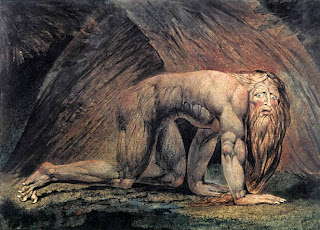
Art: Nebuchadnezzar by William Blake
The general who came to destroy Jerusalem was Nebuzaradan. He had three hundred mule-loads of iron-cutting axes, but one gate of Jerusalem swallowed them all. Nebuzaradan wanted to retreat, but the Heavenly voice told him, "You always wanted to destroy Jerusalem; now is your chance." With the wooden handle of a hatchet, he destroyed all the gates, conquered Jerusalem, and burned the Temple.
Nebuzaradan saw the blood of Zechariah seething on the floor of the Temple. He asked, "What is it?" They told him, "Blood of offerings that spilled." He brought offerings, but it did not look the same. He then threatened torture, and they told him the truth: Zechariah prophesied about the destruction of the Temple, and they killed him, a Kohen, and a prophet. Nebuzaradan then brought the Sages and slew them over the blood, but it did not rest. He killed schoolchildren and Kohanim and kept killing until the count came to 940,000. He then called to Zechariah, "Do you want me to kill everyone?" - and the blood rested.
Nebuzaradan then reasoned, "If for killing one person God punished them so, what will He do to that man (meaning himself)?" He then sent a will to his household and converted to Judaism.
Art: Nebuchadnezzar by William Blake
Tuesday, May 18, 2010
Sanhedrin 95 - David, Yishbi, and Avishai
God told David, "Because of you the inhabitants of Nov were killed, Doeg lost his share in the World to Come, and Shaul with his three sons died. Do you choose for your descendants to be obliterated or for yourself to be delivered in the enemy's hand?" David chose the second, and Satan, disguised as a deer, drew the hunting David into the land of the Philistines, where Yishbi, the brother of Goliath, captured him.
Yishbi put David under an olive press, but the ground under him softened through a miracle. Yishbi was still sitting on top.
Avishai, one of David's officers, was preparing to shampoo his hair for Sabbath when he saw bloodstains in the water and understood that David was in danger. He reasoned, "One can not ride on the king's horse - but what about in the time of danger?" They told him that in times of danger, it is allowed. He then mounted David's mule and rode off. The road miraculously contracted under him.
On the road, Avishai saw Orpah, the mother of Yishbi. She tried to kill him with a spindle, but he killed her instead. Seeing Avishai approach, Yishbi threw David up and prepared a spear to catch him. Avishai said the name of God, and David hung in the air. Avishai then asked David what he was doing there, and David explained that he had chosen punishment for himself. Avishai advised him to leave the punishment for his descendants and save himself from the trouble. Avishai then said another name of God, David came down, and the two started running away. Yishbi kept pursuing them until they told him, "Look at your mother in the grave," after which they killed him.
After this David's soldiers swore to him, "You must no longer go forth with us in battle, so that the light of Israel not be extinguished."
Art: Hunting Deer by Frans Snyders
Yishbi put David under an olive press, but the ground under him softened through a miracle. Yishbi was still sitting on top.
Avishai, one of David's officers, was preparing to shampoo his hair for Sabbath when he saw bloodstains in the water and understood that David was in danger. He reasoned, "One can not ride on the king's horse - but what about in the time of danger?" They told him that in times of danger, it is allowed. He then mounted David's mule and rode off. The road miraculously contracted under him.
On the road, Avishai saw Orpah, the mother of Yishbi. She tried to kill him with a spindle, but he killed her instead. Seeing Avishai approach, Yishbi threw David up and prepared a spear to catch him. Avishai said the name of God, and David hung in the air. Avishai then asked David what he was doing there, and David explained that he had chosen punishment for himself. Avishai advised him to leave the punishment for his descendants and save himself from the trouble. Avishai then said another name of God, David came down, and the two started running away. Yishbi kept pursuing them until they told him, "Look at your mother in the grave," after which they killed him.
After this David's soldiers swore to him, "You must no longer go forth with us in battle, so that the light of Israel not be extinguished."
Art: Hunting Deer by Frans Snyders
Sanhedrin 94 - Chizkiah and Sancheiriv
Why is Chizkiah called by this name? Because he strengthened (Chizek) the heart of Israel toward their Father in Heaven. What did he do? He thrust a sword near the entrance to the study hall and said, "Whoever does not engage in Torah study will be pierced by this sword." He then supplied the oil to light the study halls. They searched all of Israel and could not find one unlearned person who was not well-versed in the Torah. Then, they searched within the territory of Judah and could not find even a young boy or girl, man or woman, who was not well-versed in the most intricate laws of ritual purity. In this generation, people neglected their most valuable land because of the Torah study.
Sancheiriv understood the prophecy of Isaiah as referring to him conquering Jerusalem. His army then made a ten-day journey in one day. When Sancheiriv reached Jerusalem, they built an observation platform for him, and he was amazed at how small the city was compared to the ones he had previously conquered. He told his soldiers to go to sleep, rest, and be ready to take the walls of Jerusalem apart in the morning. During the night, the angel of God came and burned the soldiers.
Art: A woman reading by candlelight by Godfried Schalcken
Sancheiriv understood the prophecy of Isaiah as referring to him conquering Jerusalem. His army then made a ten-day journey in one day. When Sancheiriv reached Jerusalem, they built an observation platform for him, and he was amazed at how small the city was compared to the ones he had previously conquered. He told his soldiers to go to sleep, rest, and be ready to take the walls of Jerusalem apart in the morning. During the night, the angel of God came and burned the soldiers.
Art: A woman reading by candlelight by Godfried Schalcken
Subscribe to:
Comments (Atom)