Wednesday, September 13, 2023

Bava Metzia 4 - The case of "here, it (your money) is yours" (Finds)

A plaintiff claims to a defendant, "You owe me a hundred zuz  ($5000)," and the defendant says, "I owe you only fifty zuz, and here, it is yours – I haven't spent them, and they are in your legal possession."

Rabbi Chiya says that the defendant has admitted part of the claim and has to take an oath.

Rav Sheshet says the fifty zuz are viewed as if the lender is holding them. The defendant admits nothing about them and completely denies the other fifty. Thus, there is no oath, and he is not liable for anything else.

Art: The Argument by Norman Rockwell

Sunday, September 10, 2023

Bava Kamma 102 - Question about the laws of Shmita year (Torts)

Every seven years, a farmer in Israel is supposed to give rest to the land. Foodstuff that grew of itself can be collected and eaten, but after the harvest is over, one cannot keep it in his home but should put it out in the street for everybody's consumption. Wood is included in the laws of shmita.

However, Rava noticed a contradiction. A rule about cane reeds and grapevine leaves states that if these are gathered for food, then they have the laws of shmita, but if they are gathered for kindling - they do not have the laws of shmita. He resolved the contradiction: the laws of shmita apply to produce where the benefit and consumption come simultaneously, just like with food. 

For example, wood is burnt (and destroyed) in an oven, but the benefit (baking) comes later. On the other hand, dyestuff is destroyed when dissolved in water, and the benefit - dying the cloth - comes simultaneously. The laws of shmita apply only to stuff that is destroyed simultaneously with giving benefit.

Art: Harvest Camille Pissaro


Tuesday, August 22, 2023

MosesAI answers questions

MosesAI is a conversational chatbot trained on Talmud Illuminated. It knows all of Talmud, so ask any question.

Here: https://mosesai.org/

Art: Moses by Pietro Novelli

Sunday, August 20, 2023

Kiddushin 6 - Say what you mean

The standard procedure of getting married is a man saying to a woman, "Behold, you are betrothed to me." But if he uses a different unequivocal formula, it also works. For example, "Behold, you are my wife," "You are my betrothed," and "You are acquired to me" are all valid declarations of kiddushin.

What if he uses expressions that hint at the language of the Torah but can be interpreted otherwise? For example, "You are singled out for me," "You are my helpmate," "My taken one?" The Talmud resolves at least the last question positively because the Torah said, "When a man shall take a woman."

Let's return to the "You are singled out for me" question. What are the exact circumstances here? If they are talking in general about the subject of marriage, and then he gives her the money, even if he does not say anything else, she is betrothed. And if they were not talking about marriage, what is she agreeing to? The answer is that if he is silent, she is indeed betrothed. It is when he adds these words, does he maybe mean to hire her for work? And here, the Talmud does not have an answer.

Art: The Betrothal by Jacobus Buys


Wednesday, August 16, 2023

Kiddushin 39 - Reward for a Mitzvah is Another Mitzvah

Orlah (prohibition of the first 3 years of a tree's fruit) reads as follows: in Israel, it is forbidden; if in doubt, it is also prohibited. Outside of Israel, one can go to the field where the Orlah tree grows and buy the fruit, provided that one does not see it being picked.

One who performs an extra mitzvah is getting the goodness of performing another mitzvah, and his life is extended to do it. Thus, the reward for a mitzvah is only another mitzvah, except for respect for the parents and sending away the mother bird, for which extended life is promised.

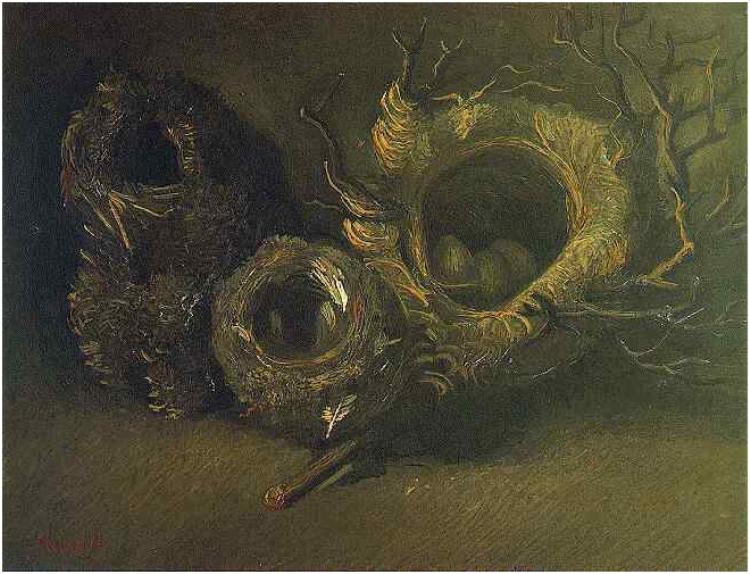
Art: Still Life with Three Birds' Nests  by Vincent van Gogh

Kiddushin 37 - Mitzvot Done in the Land of Israel and Outside

Every commandment that is dependent on the land applies only in the Land of Israel, and every commandment that is not dependent on the land applies both in the Land of Israel and outside the Land, except for the commandments of Orlah (prohibiting first 3 years of tree's fruit) and forbidden mixtures of planting. 

Then why, in connection with the Mitzva of Tefillin, does the Torah say, "And it will come to pass when God brings you to the Land of Canaanaties...?" - It means to say, "Perform this commandment, for on account of it you will merit to enter the Land."

Art: Apple Picking by Homer Winslow

Wednesday, June 7, 2023

Gittin 37 - For the benefit of both rich and poor

The term "prosbul" is related to the Greek prosbuleibutei (a council to protect people from harm) and means "benefit or rich and poor." Rich - because they do not transgress - do not refrain from helping with a loan. Poor, because it helps them obtain a loan.

Prosbul works by assigning the loan to court for collection. It is then "as if collected," and such a loan is not canceled by the 7th year.

Only unsecured loans are canceled and thus require prosbul. Even if a debt is canceled by the 7th year, it is meritorious to return the money as a gift.

Art: The Thankful Poor by Henry Ossawa Tanner