skip to main |
skip to sidebar

How do we know it? The Torah said, “And if his slaughter is for the sake of peace offering.” You could argue and say that the Torah needs to specify that it is a peace offering, and not something else. To that the answer is that the Torah already called it a peace offering in “one carries the blood of the peace offering.” What does it teach then by saying “his slaughter is for the sake?” - that it needs to be for the sake of the specific offering.
The “for the sake” requirement for other services is derived from similar verses. There is also an analogous requirement “for the sake of the owner of the sacrifice.”
Art: Gustave Bauernfeind - At the Entrance to the Temple Mount, Jerusalem

On the other hand a Get, written not for the sake of one's wife, but for the sake of a different women (provided that they have the same names) is invalid. Even if it is written for the sake of an idolatress, to whom the laws of Jewish marriage do not apply, the Get is still invalid. Thus, in the case of Get the intent for something completely different does invalidate it. Why is this difference?
He answered that in the case of divorce, if one takes the idolatress out of the picture, this Get is not intended for his wife and is thus invalid, but with sacrifices, if you take the intent for non-sacrificial meat out of the picture, it becomes no intent at all, and such sacrifices are valid.
Art: Piero della Francesca - Portraits of Federico da Montefeltro and His Wife Battista Sforza

Exceptions to this rule are a Pesach sacrifice brought on Passover, and a sin-offering. These two, if slaughtered not for their own sake, are completely invalid.
Ravina said to Rav Pappa, “It's a pity that you were not within Shabbat boundary and could not come to us Friday night, for Rava asked a great question and resolved it.” What was it?
Rava found this contradiction: the sacrifice is not counted if slaughtered for a “wrong designation,” but if there is no designation, it is valid. A woman's Get, on the other hand, has to be written expressly for her, but if there is no designation, it is invalid. And he answered: a sacrifice, without a designation, is intended for its sake, but a woman, if not otherwise specified, will continue to be married, and does no intend to be divorced.
Art: Gerard Ter Borch - Woman Reading a Letter

Five things are conducive to retaining one's learning: eating wheat bread, eating lightly cooked eggs, regular consumption of olive oil, regular enjoyment of wine and aromatics spices, and drinking water left over from producing a dough.
Rabban Shimon ben Gamliel instituted that the Prince (he occupied this position) should be given more honor than the President of Court (Rabbi Nathan) and than the leading Sage (Rabbi Meir). They wanted to overthrow him, and plotted to suddenly ask him to expound Ukzin, the hardest tractate of Mishna. A friend, however, warned him, so he studied all night and was able to expound on the next day. However, Rabban Gamliel forbade Rabbi Meir and Rabbi Nathan to enter the study hall, and they had to write their answers in a piece of paper and throw them inside. The Sages petitioned for them, and they were readmitted, but when their teachings are quoted, they are not mentioned by name, but as "others say."
Art: John Singer Sargent - Venetian Wineshop
End of Horayot
When a High Priest needs to observe mourning, he tears his garment from the bottom, and not from the top, like regular priests and laypeople do. He brings sacrifices even on the first day of mourning, just does not eat them, while regular priests do not bring sacrifices.
When one has any two mitzvot that he can perform, he should first do the one that is more frequent, and this is derived from the order of sacrifices in the Temple. If one mitzvah is more sacred than the other, it has to be done first. If the High Priest's bull and the assembly's bull, brought for a court's error, are both standing to be sacrificed, the High Priest's bull goes first – not based on the above rules, but because it is called “first” by the Torah.
If a man and a woman both need food or clothing, the woman takes precedence, because the man can go begging door to door. When both are held captive, the woman is ransomed first.
Art: Old Clothing Merchant in Cairo by Jean-Leon Gerome

If one wants to undertake a business venture and wants to know if it will be successful or not, let him raise a rooster for the sake of that business venture and let him see: if the rooster grows plump and fine, it is a good omen that he will be successful.
If one wants to go out on the road and wants to know if he will return home safely or not, let him stand in a dark house. If he sees a shadow of his shadow, know that he will return home successfully.
And it is not a wise thing for one to do, for if the omen is negative, he may become distressed, and his luck might indeed take a turn for the worst. For this reason, the omens are formulated to consider only the good outcome.
Art: Ferdinand Loyen Du Puigaudeau - Chinese Shadows, the Rabbit

The difference between an anointed High Priest and one who was installed with additional garments is that only the anointed Priest brings a special bull sacrifice if he sins or the court errs.
If a High Priest becomes ritually impure or otherwise temporarily unfit for service, another High Priest is appointed in his stead. When the first one returns, he is called The Serving High Priest, and the temporary substitute gets the name of High Priest Who Passed out of Service. The Serving High Priest is higher in that he brings the bull of Yom Kippur and his daily flour offering. They are equally commanded to marry a virgin and cannot marry a widow. Both cannot observe mourning, and accidental murderers return from their exile on the death of both.
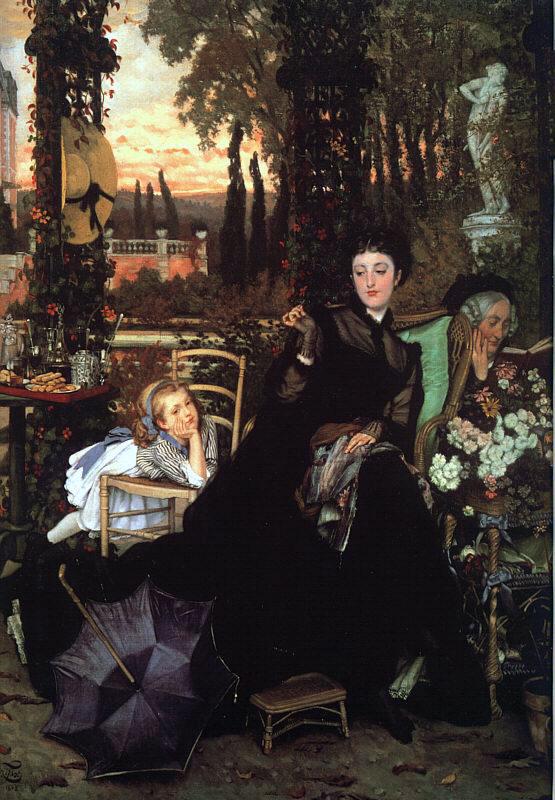
Art: James Jacques Joseph Tissot - A Widow