Sunday, January 6, 2008

My new havruta

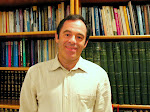
I was sitting across Borders in the Galleria when this guys appears with long tzitzit and Artscroll Bava Metsia in his hands!

I waive my Nedarim, he waves his Talmud, and he asks what am I learning. I am learning about a person who vows not to sleep today if he sleeps tomorrow. We discuss the case for a while, then I ask about his learning.

He is learning a case of a woman who damages somebody, and the statement that the husband does not have to pay for her because she has no money. The Talmud suggests that she should sell the value of her ketubah as a risk investment, and then goes into false witnesses.

We learn for half an hour and become good friends. I send his picture to my wife, her reaction "You have changed a lot!"

Monday, December 3, 2007

Rebecca's Dvar Torah

is here, comments are most welcome.

Thank you,
Mark

Joseph and Zuleika

Jami (1414-1492) described the story in his poem Yusuf and Zuleika. The Medrash story about all Zuleika's friends cutting their fingers is retold as follows:

The poem now pursues the Scriptural account of the life of Joseph, or Yussuf, whose supernatural beauty is, however, described as being the special gift of God and recorded to have been so great that no woman could look on him without love. Zuleika, therefore, only shared the fate of all her sex. 


Some writers say the ladies who clamored so much against her for her passion were, when he first entered the chamber where they were all assembled, in the act of cutting pomegranates, some say oranges, and in their admiration and amazement cut their fingers instead of the fruit! 

Yussuf is considered the emblem of divine perfection, and Zuleika's love is the image of the love of the creature toward the Creator: some go so far as to say that we ought to follow her example and should permit the beauty of God to transport us out of ourselves. The rapid change from prison to the high estate of Yussuf they consider a type of impatience of the soul to burst its fetters and join its Creator. Yussuf was always surrounded with celestial light, typical as well of the moral beauty and wisdom which adorned his mind. He is sold as a slave, and Zuleika becomes his purchaser, to the great rage and envy of all her rivals, amongst whom was included the Princess Nasigha, of the race of Aad. 

The beautiful Yussuf now enters her service, and, at his own desire, a flock of sheep is given to his special keeping, his admiring mistress wishing, by every indulgence, to attach him to her. The nurse of Zuleika is the confidante of the passion which she cannot control and which, at length, in an imprudent moment, she discloses to its object himself. 

His father, Jacob, or the angel Gabriel in his likeness, appears to warn him of his danger, and he flies, leaving his mistress in an agony of despair, rage, and grief. She thus exclaims: 

Is this a dream?—another dream,


Now continue with the poem,


Is this a dream?—another dream,
Like that which stole my senses first,
Which sparkled o'er my life's dull stream,
By idle, erring fancy nursed?
Was it for this my life I spent
In murmurs deep, and discontent—
Slighted, for this, all homage due,
From gen'rous, faithful love withdrew?
For this, no joy, no pomp have prized;
For this, all honors have despised—
Left all my soul, to passion free,
To be thus hated—spurned-by thee?


The poem is called "The Women of Memphis" and can be found here (search for entry 224). It is lovely.

In the finale of the story Zuleika, old and imprisoned, sees Yusuf in his kingly attire. She runs to him, and Yusuf, recognizing that she is the true love, marries her. Zuleika becomes young again through a miracle.


The Sefer Gilgulei Neshamot tells that the reincarnation of Joseph was Yehoshuah, and the reincarnation of Zuleika was Rahav, one of the four most beautiful women in history. Yehoshuah married Rahav, making the poet finally correct.

Wednesday, November 28, 2007

Great, amazing stuff


Reading the Artscroll Tikkun on the sixth floor of the garage, I found that the names Zerach and Perez have mystical connotations, explained by Rabbi Nechunia ben Hakaneh (Ana B'Koach), head of the 5th century Kaballah school.

Zerach is the Sun which shines (Zarach) and Perez is the Moon which is sometimes breached (Paraz). It would be appropriate for the Sun to come first, and Zerach showed his hand first. But David was destined to come from Perez, so Perez became the firstborn.

There were 30 generation of Jewish kings corresponding to the 30 days of the month. The first was Abraham who was called a prince, David was 14th, almost full Moon, and Shlomo was 15th, the full Moon. The last one was Hizkiyahu, whose sons were killed and who was blinded.

During some time when it was forbidden to declare New Moon, the court still did it. The code phrase was "David Melech Israel Chai VeKayam". The gematria of this phrase is the same as of "Rosh Chodesh".

Friday, November 9, 2007

Lucked again


I can not believe it, another Friday afternoon learning! Wishing the same to everybody!!!
Only this time it is decaf with skim milk :)

Thursday, November 8, 2007

Im lo tedi lach, ha yafa banashim


"If you do not know, o fairest of women, follow the footsteps of the sheep and graze your kids" (Song of Songs)

The drash I knew is "if you, the Jewish people, do not know what to do, follow in the footsteps of your forefathers".

The Talmud in Ketubot top of daf 67 gives a different interpretation, "if you, the Jewish people, do not learn and therefore do not know Torah, you will have a burden of work placed on you, such as tending to your own sheep".

Sunday, October 14, 2007

If Mr. Rascal blows up Mr. Victim in his Porsche

Then it is logical to say that Mr. Rascal should pay for the Porsche with his money, and for Mr. Victim's life with his life.

That is indeed what happens in the American court system. For example, O.J.Simpson was first tried in the criminal court (and acquitted) and then in a civil court (and ordered to pay).

For the last few days in Ketubot we learned the opposite. If Mr. Rascal is tried in the Jewish court, he will have to face criminal charges, and because he may loose his life, he is spared the payment!

It seems that from here we can see the answer the Talmud gives to the unsolved question in the American law, namely, the crime and punishment theory.

Among all possible views, there is one that we want to restore Mr. Victim to the state before the crime, or that we want to punish Mr. Rascal, or that we want others to be deterred.

If in the Jewish court we do not care what the state or Mr. Victim will be, it must be that we are only concerned with punishing Mr. Rascal. When we want others to be afraid, it is specifically mentioned.

In the Jewish law, this result comes out because we are only concerned with the correction of Mr. Rascal's soul, while Mr. Victim is already corrected. This should rule out the same point of view in the American law, because it is not a practical reason.