About Samuel the prophet, it says that a razor ("morah") will not pass over his hair. This means that he was a nazir, just like Simeon, about whom the same is said. This is the opinion of Rabbi Nehorai.
However, Rabbi Yose translates the word “morah” as fear and says that fear of man would never be upon Samuel. To this, Rabbi Nehorai replies that Samuel was afraid once when he said, “What if the king hears and kills me?” The answer of Rabbi Nehorai is not given here.
The same Sages agree on something else, though. Rabbi Yose says that the one who responds with “Amen” (which signals his agreement to the blessing) is greater than the one who says the blessing. Rabbi Nehorai said, “By Heaven, so it is! Look at a battle: regular soldiers start, but champions seal the battle.” And yet, another Sage disagrees and says that one should rush to say the blessing first because he is then blessed from Heaven first – and afterward, the one who answers “Amen” receives the same reward (but not greater).
And talking about battles, Sages, through their Torah study, increase peace in the world since their war of arguments substitutes for the physical conflict.
Art: The Soldier's Return by Girolamo Induno
Showing posts with label Nazir. Show all posts
Tuesday, October 27, 2015
Friday, October 23, 2015
Nazir 62 – Willing slaves
A slave acquired by a Jew has to undergo circumcision and accept on himself the majority of the mitzvot: he will be obligated to keep all the "don't do” prohibitions but not all of the “do” commandments. Thus, his obligations are the same as a Jewish woman keeps.
What happens if a slave does not want to undergo circumcision or accept the commandments? – The master can keep him for a year to see if he changes his mind, but afterward, must sell him back.
Another uncommon feature of such slaves is that if the master accidentally or intentionally kicks out his tooth, eye, or finger, the slave goes to freedom. Once any slave acquires his freedom – he cannot be made a slave again. In fact, he becomes a full Jew, with the additional mitzvot of a Jewish man.
There is a difference between the laws of nazir for women and for slaves. For a woman, a husband can annul her vow, particularly of becoming a nazir (nazirah). The annulment is still active if they divorce or if the husband dies. However, with the slave, it is not so. While the master can force the slave to drink wine and go to a cemetery, this does not cancel the vow; when the slave goes free, he needs to complete his term of nazir.
Art: Slaves on the West Coast of Africa by Francois-Auguste Biard
Nazir 61 – Who can become a nazir?
A Jewish man can become a nazir, but a non-Jew cannot. Also, a Jewish woman can become a nazir (nazirah), and one can even force his slave to become a nazir.
All three rules above are not obvious. Why is it that a non-Jew cannot become a nazir? – Because the Torah said, "Speak to the sons of Israel," but not to other peoples. However, this cannot serve as proof because later, the Torah uses the term "man," which should mean "any man." In fact, a non-Jew can bring sacrifices in the Temple, so why can't he be a nazir?
Perhaps it is because a nazir is not allowed to bury even his father, and maybe for a non-Jew, it is different? – Can't be because inheritance laws apply to all people, including inheriting from the father. Or perhaps it is because a nazir should avoid impurity, and a non-Jew, since he does not go to the Temple and does not have the concept of impurity, cannot be a nazir? – No, that is not convincing either: perhaps he does have a concept of impurity, just that he gets no punishment for being impure!?
The Talmud tries a few more attempts but concludes that this rule is impossible to prove. Rabbi Yochanan summarized that God tells this law directly to Moses and not written anywhere in the Torah.
Art: Burial on The Plains by Richard Lorenz
Wednesday, October 21, 2015
Nazir 59 – Two nazirs, complicated further
Continuing the story of two nazirs, one who became ritually impure and had to bring sacrifices together, making conditional statements about whose sacrifice it was, let us suppose that one of them dies. Now the surviving one does not have a friend with whom to make those conditions. What is he to do?
He must find someone "in the street" willing to help. This volunteer has to put himself in a condition of doubt by saying, "I adopt to be a nazir, but conditionally. If the survivor was impure, I am a nazir immediately." After thirty days, they bring the same two sets of sacrifices, one required for a pure nazir and one for an impure one, and declare that if the survivor was impure, then the impure sacrifices are his, and the other ones are for the volunteer. But if the survivor was pure, the pure sacrifices are his, and the impure ones are offered as sacrifices in doubt (since such a category exists). Then the volunteer continues, "If the surviving nazir was pure, then my term of being a nazir starts after thirty days." Then they keep offering more sacrifices and making more conditions.
This was the opinion of Rabbi Yehoshua. But Ben Zome asked, "Who will go out to this extent to extricate his friend out of his doubts?" Rather, the survivor should bring the minimal sacrifice that would allow him to conclude his being a nazir, even though they involve bird sacrifices, which is not standard - but it will enable him to achieve his purpose. Even though Rabbi Yehoshua argued that this was not the preferred way, the Sages agreed to Ben Zoma as more practical.
A question to Rabbi Yehoshua: "What is really wrong with Ben Zoma's solution?" - Actually, nothing; Rabbi Yehoshua just wanted to sharpen the minds of his students with a more complicated one.
Art: David Street in Jerusalem by Gustave Bauernfeind
Tuesday, October 20, 2015
Nazir 57 – One out of two nazirs
If two nazirs (correctly, nazirim) were walking together on the road, and somebody saw that one of them became ritually impure, they have a problem on their hands. The impure one must shave and bring sacrifices to purify himself, and the pure one simply continues being a nazir. But they don't know who is who.Here is their way out. They both continue being nazir until the end of their term. Then they both shave because it would be required for both pure and impure nazir. Then they take two sets of sacrifices, one for a nazir who is pure, and another, a different set, for one who is impure, and bring them together to the Temple.
Each of them now says: "If I am really pure, and my friend is impure, then the sacrifices of purity are mine, and the other set is his." Then they bring both sets. But this works only for a pure nazir. Now they continue for yet another thirty days, and at the end, they bring just one set of sacrifices – for the nazir who is pure. Each one says: "If I was the pure one – then this sacrifice is my friend's, and previously my sacrifice was already brought. But if I was the impure one, then this sacrifice is now mine."
The Talmud then asks: why is there any doubt at all? We know how to resolve all such doubts based on the laws of the doubts of a suspected wife (next Tractate). That is, if the suspected people hid, the doubt is confirmed. And if they were in a public place, there is no doubt at all. Here they did not hide from the one who saw them!? – He was far, so it is as if they were hiding.
Art: Portrait of a Clean-Shaven Young Man by Lucas The Elder Cranach
Friday, October 16, 2015
Nazir 55 – Nazir outside of Israel?
The Sages decreed that anyone who left Israel would immediately become ritually impure to discourage people from leaving the Land of Israel. Ostensibly, this is because people who live outside of Israel are not as careful marking off graves (ground-based impurity), and one can pass over an unknown grave. However, the Sages may have declared the airspace outside Israel impure (air-based impurity).
The laws of nazir may shed some light on this. A nazir who went outside of Israel becomes ritually impure and will have to continue his days after he purifies himself. We also saw that he purifies himself with the ashes of Red Heifer. Now, the ashes are only needed for the impurity of the dead. This proves that the out-of-Israel impurity was because of the unmarked graves, and it is a ground-based impurity, does it not? – Actually, no. It could be that this is sheer air-based impurity, and the ashes of the Red Heifer are mentioned only regarding a plowed-over cemetery but not anything else.
Art: Graveyard under Snow by Caspar David Friedrich
Thursday, October 15, 2015
Nazir 54 – Not to shave!
There are cases when the ritual impurity does not really exist, but it was “decreed by the Sages.” Take, for example, a field where a grave was previously located, then the location of it was lost, and then the field was plowed over. Since anyone who is walking through the field can potentially touch a bone and become impure, the Sages said that such a field should be treated as ritually impure, and anyone who went through it without precautions will have to purify himself.
However, from the Torah point of view, accidentally touching a bone is unlikely because a plow does not usually reach that deep, and the person is really pure. A nazir who becomes impure should cut his hair and bring sacrifices, but a nazir who is pure is not allowed to touch even one hair. What is a nazir to do if he passes through a “field full of fragments," as it is called?
Here is what he should do: purify himself with the ashes of the red heifer on days three and seven, and then continue being a nazir. The seven days of his impurity are removed from his count, but otherwise, he continues to count as before. And he does not shave his hair or bring sacrifices because, in truth, he is pure. Other similar cases, such as being under the same branch as a corpse (but not a real roof that transmits impurity) are treated the same way.
If, in addition to being a nazir, he became a metzora (spiritual leper), he purifies himself from that but continues being a nazir since metzora, even though it requires purification, is not the same as the impurity of the dead. Thus, he does not lose all the previous days, as he would if we were to go to a cemetery.
Art: Plowing ox By Rudolf Koller
Tuesday, October 13, 2015
Nazir 52 – Skull and spine
If a nazir comes in touch with a dead body, he loses his previous days, has to shave, must bring sacrifices, and then restart. How much of a dead body? One example is a skull and spine – just bones, even if they have no meat.
This rule had two versions; one read "skull and spine," but the other read "skull or spine." According to the second one, a skull or a spine is enough for a nazir to lose his days and shave. Which one is right?
The Talmud tries to resolve this in many ways. For example, since there are six questions related to nazir where Rabbi Akiva initially held a more stringent position but eventually conceded to the Sages, if his position was more stringent here, too, and read "skull or spine," - then the total count would be seven, not six. However, Rabbi Shimon says there was another rule about a "quarter-measurement of blood from two different deads," which Rabbi Akiva never conceded. This changes the count and ruins our proof.
Incidentally, Rabbi Shimon emphasized his points: "While Rabbi Akiva was alive, he never changed his mind on this question, and whether he retracted after death - I don't know about that." Unfortunately, there were more refined ways of putting it. Rabbi Shimon felt remorse and fasted to atone for it until his teeth darkened.
Art: An old man, holding a skull by Jan Lievens
Sunday, October 11, 2015
Nazir 47 – Who is more important, nazir or High Priest?
What if a High Priest and a nazir find this corpse together – who is obligated to bury this dead and thus preserve the other one from becoming impure? This should be the High Priest because to purify himself, he only needs to wait for seven days and get himself sprinkled with the ashes of the Red Heifer. By contrast, a nazir would need to bring special sacrifices before he can restart being a nazir. This is the opinion of Rabbi Eliezer. The Sages say just the opposite. Nazir should bury because his limitations are temporary, whereas the High Priest should always be pure.
In this argument, the positions are clearly stated. But now the Talmud compares other gradations, such as the Priest Anointed for War and a Deputy High Priest; who is more important? This is resolved as follows: to preserve the life of the Priest Anointed for War, he is more critical because he serves the needs of many people. But concerning purity, the Deputy is more important concerning purity because he can be called to serve in the Temple any time the chief High Priest becomes impure.
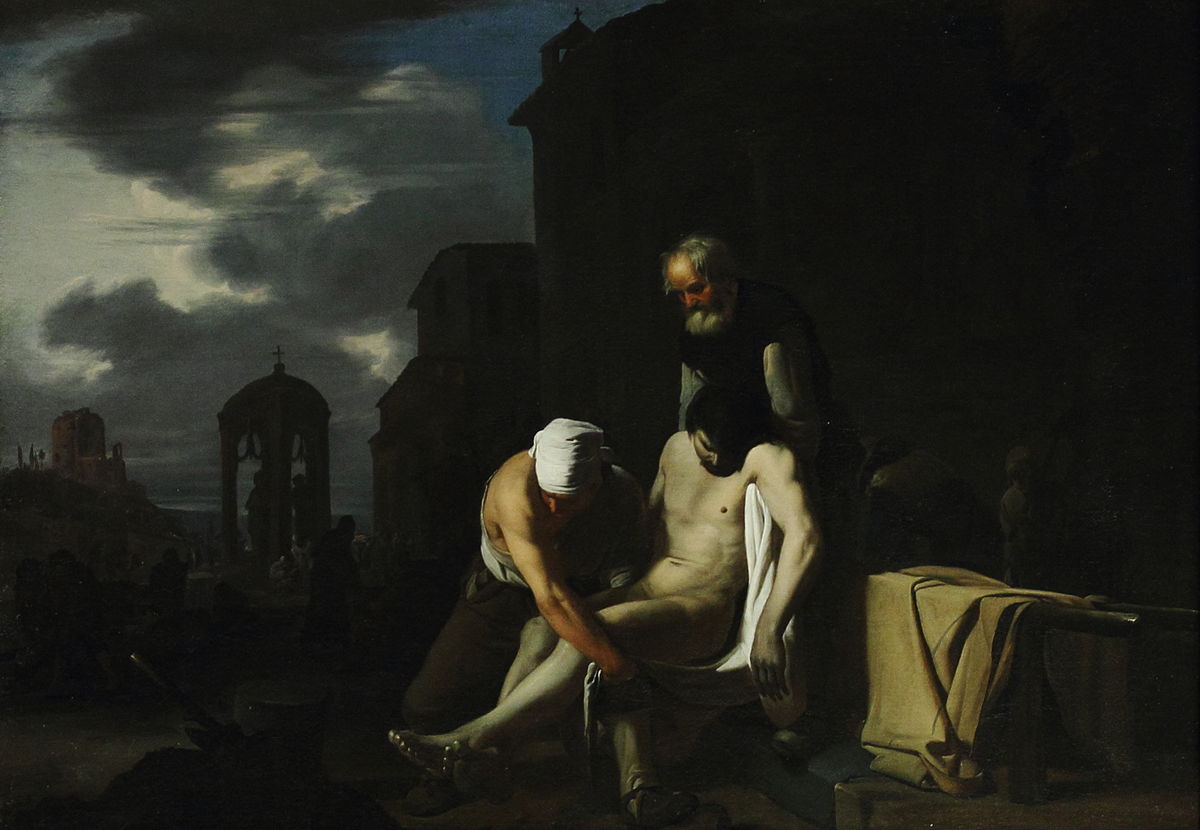
Art: Burying the Dead by Michael Sweerts
Sunday, October 4, 2015
Nazir 43 - How to get multiple punishments
If a nazir is warned not to drink wine, and then he drinks all day, he is liable only for the first drink. However, if they warn him again before every sip, he is liable (to lashes) for each separate act.Similarly, if they tell him not to become ritually impure by coming in contact with a dead body, and he does it, he is liable only once. Still, he is liable multiple times if they keep warning him before each act.
But how can one be liable for ritual impurity more than once? Once he is impure - that's it, and he cannot become any more impure than this!? - He can achieve it by coming into a house where there is a dead body (for this is a separate prohibition) and then actually becoming impure.
However, this is not possible. If his nose comes in first, he is already impure but has not entirely come into the house. And if he leans back, so his nose is in line with his body, his toe comes in first!
We can invent a solution: he should come in while in a big box, since big boxes protect from impurity. And then somebody must remove the roof of his box. For this, he really does get punished twice - provided that he assists in removing the roof, for otherwise, it is not he but the one who removed the roof would be to blame. Thus, we found an answer.
Art: Peasants Drinking In A Tavern by Jan Miense Molenaer
Friday, October 2, 2015
Nazir 40 – Real shaving is done with a razor
The Torah said about a nazir that a "razor shall not pass over his head." However, the words "razor" or really "no razor" is already sufficient for us to know the law. Then why are the words "will not pass over his head" written at all? – to include any other way of hair removal, such as pincers or depilatory, and to make it prohibited for nazir to remove his hair in any way.
But now the word "razor" becomes extra: if, in the end, the Torah is going to prohibit all kinds of hair removal, then why mention "razor?" Now, this teaches an additional law: that when the nazir concludes his term and shaves his head, that shaving must be done only with a razor. If he uses any other instrument, the shaving does not count; he has to re-do the last thirty days of a nazir and shave again, this time correctly.
There are, in general, three categories of people who must shave all their hair: a nazir, a metzora (spiritual leper), and all Levites on the day of their first inauguration for Temple service. The Talmud tries to derive the laws of one of these categories from the others.
Art: Portrait of a Clean-shaven Man by Lucas The Elder Cranach
Wednesday, September 30, 2015
Nazir 39 – The direction of hair growth
If a nazir shaves his head – or bandits grab him and shave it – he must wait at least thirty more days before concluding his term. This is because the standard (and the minimal) term is thirty days, and when he shaves his hair, it must have at least thirty days of growth.
A question: is the hair growing from the root or the end? Why would we want to know? – If the hair is growing from its root, and the bandits gave him a haircut but left seven days' worth of hair growth on his head – does he now wait for thirty days still, or only for twenty-three? For example, if the hair grows from the root, then that hair he consecrated has grown down by now and was cut by the bandits, so he will have to wait another thirty days. But if the hair grows from the end down, then he will only need twenty-three days. So?
Let's look at a nit (louse). It always remains at the root – so it must be that the hair grows from the end! – Not so fast! Maybe the nit is alive and keeps crawling to the root. Well, let's look at a dead nit – it is always found at the end of the hair, so it must grow from the root! – No, because perhaps when the nit is dead and cannot resist gravity, it keeps sliding down as the hair grows.
The final proof comes from the beards of old men who die them black. We see that the whitish color of gray hair appears at the root – so it is proven that it grows from the root!
Art: Portrait of a bearded old man by Rembrandt Van Rijn
Sunday, September 27, 2015
Nazir 33 – Five answers to one problem
Six people were walking together on the road, and they saw someone coming toward them. The first said, "I am a nazir if this is John." The second one said, "I am nazir if this is not John." The third one said to the first two - "I am a nazir if one of you is now a nazir." The fourth one said, "I am a nazir if one of you two is not a nazir." The fifth one said, "I am a nazir if both of you are nazirim." And the sixth said – talking to all five – "I am a nazir that you are all nazirim." What is their status?
1) Beit Shammai says that they are all nazirim. They all wanted to become nazirim and added their qualifications as a by-the-way, but not essential to their vow.
2) Beit Hillel said that only those with fulfilled conditions become nazirim. This is the most straightforward logic.
3) Rabbi Tarfon says that nobody is a nazir. A conditional vow does not make a nazir; it must be clear and direct.
If now the person in question suddenly turned back, and they never found out who he was, what is their status then?
4) Rabbi Yehudah says that no one becomes a nazir because a person never accepts to be a nazir out of doubt.
5) Rabbi Shimon says that he has a real problem: he is a nazir out of doubt, but cannot get out of this because only a real nazir is allowed to shave his head, so if he is not a nazir, he cannot complete his vow. Therefore, he should declare: "If I am a real nazir – well and good, but if not, I am now become one out of my free will."
Art: Still Life With Wine, Bottles, And A Cigar by Christian Schmidt
Friday, September 25, 2015
Nazir 32 – They knew when the Temple would be destroyed
If one became a nazir but kept drinking wine – hoping, perhaps, that his vow would be annulled – but a Sage affirmed his vow – he continues his period of being a nazir and finishes it. However, the Sages imposed upon him a penalty: he cannot even ask about annulment until he behaves appropriately for as many days as he previously violated by drinking wine. Suppose a Sage annulled his vow of being a nazir, and he already separated an animal for the concluding sacrifices. In that case, we are back to the argument between Beit Hillel and Beit Shammai. Beit Hillel simply allow the animal to go back to its flock.
If one thought that he had an animal to conclude his nazir's vow and declared himself a nazir, but then discovered that the animal was stolen – if it was stolen before the vow, then he is not a nazir. If it was stolen after his vow, then he was a valid nazir for the time the animal was still in his possession, so his vow is valid.
Nachum HaMede made this mistake: he annulled all nazir vows for people who made them close to the Temple destruction. The Sages corrected him: if they vowed before the destruction, their vows were, in fact, valid. But they knew the Second Temple would be destroyed 490 (seventy weeks ) years after the first one, so how could they vow in earnest?! – They still hoped their period of being a nazir would finish while the Temple stood.
Art: In The Wine Cellar by Jan David Col
Thursday, September 24, 2015
Nazir 31 – Mistakes
What if one said, "The black ox, which will emerge out of my house first, shall be a sacrifice," – and instead, a white ox comes out first? Will the white ox become a sacrifice?
Beit Shammai says that, indeed, it will. Why? Because Beit Shammai claims that even done by mistake, consecrations are still valid. One cannot undo a consecration to the Temple if done by mistake. Another explanation is that he really made no mistake. He planned for the first ox to become sacred. To emphasize, he specified that it would be black (as this was more valuable to him). But even if a white one comes out first – it will become sacred, and the color does not matter.
Which reason is the real one? Do his mistakes become consecrations, or do we simply reinterpret his words to make sense? The Talmud tries to derive the answer from the rule above, but to every proof, it finds an exception disproving it. Thus, the question remains unresolved – in this particular discussion.
Beit Hillel states that his statement must agree precisely with the intended effect, and his consecration becomes valid only then.
Art: Cart With Red And White Ox by Vincent Van Gogh
Nazir 30 – Father's money
If a father was a nazir, separated some money to bring the concluding sacrifices, and died, his son can declare, “I am a nazir, and I will use my father's money for MY concluding sacrifices.” Usually, you cannot re-use someone else's sacrifice, but you can in this case.
This rule was taught by God to Moses on Sinai and has not been recorded in the Torah. But what is its logic? Is it an exception to all rules, or does it work as an inheritance? And if you say that a daughter would not share in the inheritance anyway, what if the man has only one daughter? Can she become a nazir (nazirah) and use her father's money? The rule above tells us that only a son can do so.
And yet we can ask another question. If there are many sons, do they equally share in this money? If one of the sons is a firstborn, does he get the double portion? And furthermore, is this rule valid only for a regular nazir? What about a lifetime nazir or a Samson-like nazir? – To all these questions, the Sages did not find an answer.
Art: Maria Riezler-White, granddaughter of the artist Max Liebermann
Monday, September 21, 2015
Nazir 29 – Father and son, a nazir
We said that a father can pronounce his son a nazir. This can only be true if the son is not grown up because the father would have no rights over his son's religious observances after that. Only if the son is young and the father feels that this would be a proper measure for his son's education could such a law be possible.
And yet, who mandated it? Was it the Torah that made a notable exception to its usual rules? Or did the Sages decide to give this additional power to the father? If it is the Torah, then we will not question, for example, why it gave this power to the father but not to the mother. This is indeed the view of Rabbi Yochanan. However, Resh Lakish ascribes the rule to the Sages. Now Resh Lakish will have to explain every detail of this enactment. First, he answers that only the father, not the mother, is responsible for the son's observances.
Furthermore, why did the Sages establish that relatives can annul this father's decree? – Because if the relatives teach the boy to negate the father's command, it is hardly conducive to proper education. But how did the Sages allow to shave off the hair on the head? Isn't it prohibited to shave off the peyot? Resh Lakish will tell you that shaving the whole head is permitted. And yet, how can the Sages permit an animal sacrifice of a nazir if it is not needed!? – Resh Lakish will answer that it is actually permitted to bring unnecessary sacrifices
The father of (future) Rabbi Chanina pronounced his son Chanina a nazir, and they took the boy to Rabban Gamliel to examine if he was still a child. But Chanina said, “Please do not trouble yourself. If I am still a minor, I do what my father says. And if I am a grownup, then I declare myself a nazir.”
Rabban Gamliel kissed Chanina on the forehead and predicted that he would be a great Sages, which soon came to pass.
Art: Haircut day By Hugh Carter
Sunday, September 20, 2015
Nazir 28 – A wife must drink with her husband
If a husband hears of his wife's vow, he can annul it – but only on the day he hears it. If he heard of his wife becoming a nazir (or "nazirah") on the last day of her vow, he can annul it then. However, if the blood of one of the required sacrifices was already thrown on the Altar, he cannot annul it any longer – because from then on, she is not deprived of anything and can drink wine and go to the cemetery. His rights extend only to her self-deprivation, but not further.
This is true, however, if she concluded her promised time of being a nazirah correctly. Suppose she accidentally touched a dead body and is bringing sacrifices because of that. In that case, he can still annul the vow so that she does not continue her period of abstinence because he can demand that she drink wine with him.
Rabbi Meir says that even if she did everything right, he can stop it at the last moment – because he can claim, "I don't want my wife to shave off her hair!" (which every nazir finally does). And the first teacher, what did he think? – That she can wear a wig. And Rabbi Meir? – That the husband won't like the wig.
The father can declare his son a nazir. However, his son or any relative can stop that and free the son from the obligation. Another unusual law (known only to those who study unwritten Torah): if the father was a nazir and prepared money for his concluding sacrifices but died, the son can use that money for his own nazir sacrifice. This is not true for any other type of sacrifice or money – they cannot be re-used by the son.
Art: Young Woman with a Wine Glass by Octave Tassaert
Friday, September 18, 2015
Nazir 27 – What to do with the remaining money?
If a woman became a nazir (more correctly, nezirah), fulfilled her promised term, and prepared the animal sacrifices required at the end – and then her husband annulled her vow of a nazir – the sacrifices are, of course, not needed. What should she do with them?
If the animal is from the husband's flock, it can go back to graze. The husband implicitly gives permission to his wife to use the animals – but only if she indeed has to bring a sacrifice. If, on the other hand, she used her own animals, then there is no way out, and the sin offering will have to remain in this state until it dies. What about the money she separated for the libations? – It should be dropped into the communal collection box in the Temple.
What happens if she separates metal pieces (ingots)? Such pieces were used for trading for animals and then used for metal works. The same questions would arise if one separated the ingots for his being a nazir but did not specify how they should be used and then died. Since these ingots require appraisal and cannot be readily sold, they remain in their unresolved state and should be destroyed to avoid confusion. That is what the Sages say. However, Rav Nachman disagreed. One can easily barter the ingots for animals and then sell the animals. Therefore, they are equivalent to cash. And just as cash should be deposited into communal boxes for voluntary offerings, so too the ingots should be disposed of in the same manner.
Art: Guiding The Flock by Francesco Paolo Michetti
Sunday, September 13, 2015
Nazir 19 – Deriving different things from the same word
A nazir is forbidden to visit a cemetery. Suppose he accidentally comes in contact with a dead body and thus becomes ritually impure. In that case, he needs to purify himself, shave all his hair, bring sacrifices, and restart being a nazir. Say he became impure again the night before he could bring the sacrifices. Then later, he will need to bring two sets of sacrifices. Why? – The Torah said, "He shall sanctify his head on that day and restart being a nazir" – even if he did not bring his sacrifices yet. Thus the new impurity happens to a fresh new nazir and causes another obligation.This is the opinion of Rabbi Eliezer. It results in bringing the most sacrifices. The Sages also pay attention to the extra words of "on that day," but it teaches them that that he does not restart his being a nazir until he brings the guilt offering. Thus, right now, he has not started another term yet and just needs to purify himself. This is all one long period of impurity, and later he brings only one set of sacrifices.
This seems to cover all possibilities. But Rabbi Ishmael says something else: if he did not bring all sacrifices, including the burnt offering, he is still not a nazir again. Until then, he only brings one set of sacrifices when he finishes being a nazir.
Practical law? – Follow what the Sages have said since they are the majority.
Art: View of Pere Lachaise Cemetery by Pierre Courvoisier
Subscribe to:
Posts (Atom)