skip to main |
skip to sidebar

Five things are conducive to retaining one's learning: eating wheat bread, eating lightly cooked eggs, regular consumption of olive oil, regular enjoyment of wine and aromatics spices, and drinking water left over from producing a dough.
Rabban Shimon ben Gamliel instituted that the Prince (he occupied this position) should be given more honor than the President of Court (Rabbi Nathan) and than the leading Sage (Rabbi Meir). They wanted to overthrow him, and plotted to suddenly ask him to expound Ukzin, the hardest tractate of Mishna. A friend, however, warned him, so he studied all night and was able to expound on the next day. However, Rabban Gamliel forbade Rabbi Meir and Rabbi Nathan to enter the study hall, and they had to write their answers in a piece of paper and throw them inside. The Sages petitioned for them, and they were readmitted, but when their teachings are quoted, they are not mentioned by name, but as "others say."
Art: John Singer Sargent - Venetian Wineshop
End of Horayot
When a High Priest needs to observe mourning, he tears his garment from the bottom, and not from the top, like regular priests and laypeople do. He brings sacrifices even on the first day of mourning, just does not eat them, while regular priests do not bring sacrifices.
When one has any two mitzvot that he can perform, he should first do the one that is more frequent, and this is derived from the order of sacrifices in the Temple. If one mitzvah is more sacred than the other, it has to be done first. If the High Priest's bull and the assembly's bull, brought for a court's error, are both standing to be sacrificed, the High Priest's bull goes first – not based on the above rules, but because it is called “first” by the Torah.
If a man and a woman both need food or clothing, the woman takes precedence, because the man can go begging door to door. When both are held captive, the woman is ransomed first.
Art: Old Clothing Merchant in Cairo by Jean-Leon Gerome

If one wants to undertake a business venture and wants to know if it will be successful or not, let him raise a rooster for the sake of that business venture and let him see: if the rooster grows plump and fine, it is a good omen that he will be successful.
If one wants to go out on the road and wants to know if he will return home safely or not, let him stand in a dark house. If he sees a shadow of his shadow, know that he will return home successfully.
And it is not a wise thing for one to do, for if the omen is negative, he may become distressed, and his luck might indeed take a turn for the worst. For this reason, the omens are formulated to consider only the good outcome.
Art: Ferdinand Loyen Du Puigaudeau - Chinese Shadows, the Rabbit

The difference between an anointed High Priest and one who was installed with additional garments is that only the anointed Priest brings a special bull sacrifice if he sins or the court errs.
If a High Priest becomes ritually impure or otherwise temporarily unfit for service, another High Priest is appointed in his stead. When the first one returns, he is called The Serving High Priest, and the temporary substitute gets the name of High Priest Who Passed out of Service. The Serving High Priest is higher in that he brings the bull of Yom Kippur and his daily flour offering. They are equally commanded to marry a virgin and cannot marry a widow. Both cannot observe mourning, and accidental murderers return from their exile on the death of both.
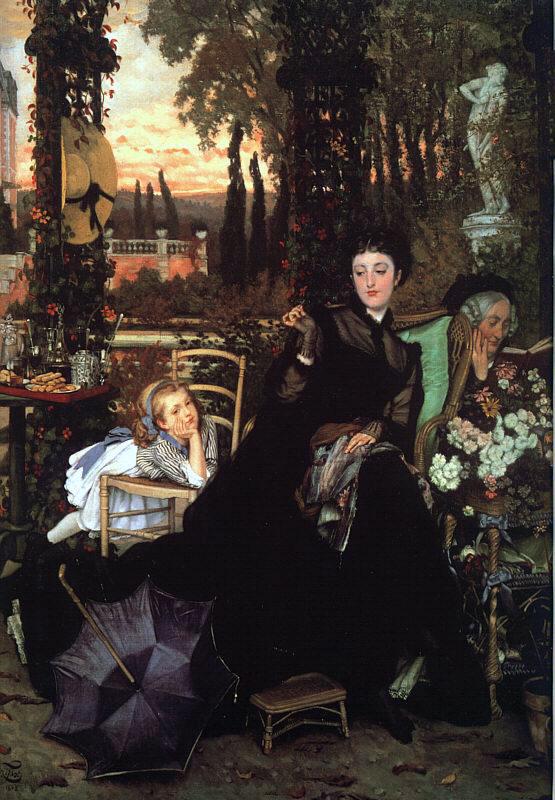
Art: James Jacques Joseph Tissot - A Widow

The High Priest is removed from his position if he develops a physical blemish that makes his service invalid. A leader is removed if he develops a sickness of tzaraat – spiritual leprosy – or if he is deposed.
Who is that leader that the Torah describes as “Prince, or Nasi,” to whom the above laws are applicable? That is the king, as the Torah describes him, “one who has no superior except God.”
The king is a servant of the people, as we see from the following story. Rabban Gamliel and Rabbi Yehoshua were traveling together on a ship, Rabban Gamliel had bread, and Rabbi Yehoshua had bread and flour. When Rabban Gamliel ran out of bread, he was sustained by Rabbi Yehoshua's flour. Said he to Rabbi Yehoshua, “Why were you so provident?” Rabbi Yehoshua replied that there is a star that misleads sailors, and it shows once in 70 years. “If you are so smart,” - said Rabban Gamliel - “Why do you have to travel on business?” Rabbi Yehoshua replied, “Before you help me, help your two students, Rabbi Elazar and Rabbi Yochanan, who know how to count every drop in the sea, but don't have bread. Rabban Gamliel wanted to appoint them heads of Yeshiva, but they did not want to. So he told them, “Don't think that I am making you rulers, rather, I am making you servants.”
Art: Emil Carlsen - Moonlilt Seascape

If the transgression was that of idol worship, an individual, the leader, and the anointed priest bring a she-goat, whereas the court brings a bull and a he-goat. The bull as completely burned on the Altar, and the goat is a sin-offering, which is partially eaten by the priests.
If one violated a commandment, resulting in a guilt-offering, and furthermore if he is in doubt about this, both an and a leader of the community bring a “doubtful guilt-offering,” but the anointed priest and the court are exempt. Regarding a definite guilt-offering, an individual, the leader, and the priest are liable, but the court is exempt.
Art: Stefano Bruzzi - Mountain Goats

The court does not bring a bull sacrifice if they rule incorrectly about a purity aspect of the Temple service, since an individual brings a different sin offering for that. Rather, it should be an error leading to a regular sin-offering, for example, the positive commandment of husband and wife to abstain before the day of expected menses, and a negative commandment not to have relations with the wife who has not been to the mikvah.
Art: Pierre Auguste Renoir - Two Sisters II
If the High Priest, anointed for service with Temple oil, is himself a Sage and ruled that something normally forbidden on the pain of excision is allowed, and then, without realizing his mistake, performed the act, he brings a special sacrifice, the “Anointed Kohen's bull.” If he knowingly ruled incorrectly or knowingly performed the forbidden act, he does not bring this sacrifice. His law is thus similar to the court's ruling that it makes for the community.
If he ruled incorrectly together with the court and performed the act together with the congregation, he does not bring his special sacrifice but is atoned for by the communal “sacrifice of forgetfulness” bull. Just as the court is only liable if it negates a part of a commandment, but not the whole commandment, so too the High Priest.
Art: John Byam Liston Shaw - And Who Knoweth Whether He Shall Be A Wise Man Or A Fool

Incidentally, they were not all “burnt offerings,” rather, the goats were sin-offerings. If so, why are they called this? - because the goats were sin-offerings for idol worship, but like the burnt offering, they were not eaten by the priest.
According to Rabbi Yehudah, who says that if some of the tribes sinned, every tribe brings a goat, we understand twelve goats. According to Rabbi Shimon, who says that tribes do not “drag” each other into asking for forgiveness, eleven tribes sinned and brought eleven offerings, and the twelfth was brought by the court. But according to Rabbi Meir, who says that only the court brings the offering, why were twelve offerings required? Rabbi Meir answers that the court sinned, changed its mind, sinned again, changed its mind again, and so on, twelve times.
If, after the mistake of the court, one of the Jews dies, they still bring an offering – since the congregation never dies – but if one of the judges dies, they do not bring an offering.
Art: Jan Victors- Jacob Seeking Forgiveness of Esau

How many bulls are brought? There are multiple opinions about it: some say that the court brings the offering, and some – that the congregation of people does it. Furthermore, each tribe is called a congregation, so there are opinions that each tribe brings an offering, some tribes bring it, and even that all tribes bring it if one tribe sinned. Some opinions require the court of a single tribe to bring an offering, but the Sages say that liability exists only for the error of the Great Sanhedrin of seventy one, which was located on the Temple Mount, in the Chamber of Hewn Stones.
Art: Paulus Potter - Young Bull 1647

What happens if an individual did it because he has not heard that the court has retracted? Rabbi Shimon always exempts him. Rabbi Elazar says that his error is in doubt, and therefore he must bring a special guilt-offering. This applies when he stayed at home and could check on the court opinion before doing the act. If he went overseas, he is completely exempt.
The court needs to forget only part of the law, but not the complete law. For example, if they ruled that there is no Shabbat in the Torah, they are exempt from the bull offering, but if they said, “There is Shabbat in the Torah, but one is allowed to carry things from one's house into the street,” - then they are liable to a communal-error bull offering.
Art: Pierre-Auguste Renoir - Man Carrying a Boy
The previous rule that one is not liable if he followed the erroneous decision of the court is the minority opinion; the prevailing opinion is that one IS liable in such case. However, if the majority of Jews acted on a court's error – who ruled, for example, that a certain action is not idol worship when in reality it is – then each individual is not liable, and instead the court brings the sacrifice for the mistake they had made. The majority in this case is determined only among the Jews living in Israel.
What if the court mistakenly ruled that a certain prohibited fat (destined for the Altar) is permitted, and then a minority of Israel acted upon that, then the court retracted their mistake, and afterwards again mistakenly ruled that this fat was allowed, and now a different minority acted upon it – do they combine into a majority? This and other similar inquiries remain unresolved.
Ignacy Aleksander Gierymski - Feast of Trumpets (Slichot)
If the court ruled to transgress one of the commandments written in the Torah - for example, they decided that a certain type of blood is allowed to be eaten, and an individual did it, relying on their words – he is free from liability. Whether he ate the blood together with them at a meal, or after observing them, or even if they just ruled it permitted, but did not do it themselves, since he relied on their words, it is not his fault.
However, if he was one of the Sages of the court, or even one of the students who was worthy to be on the court, and he knew that they erred, but he nevertheless followed their ruling, he is liable to bring a sin offering. If he knew that they erred, then why did he do it? Because he mistakenly thought that the mitzvah to follow the words of the Sages applies even in this case.
Art: Thomas Satterwhite Noble - The Price of Blood