skip to main |
skip to sidebar
According to Rabbi Yehudah, the goats brought on Festivals and the goats brought on the New Moon atone for violations of ritual purity laws, of which one never becomes aware.
Rabbi Shimon disagrees about the goats of the New Moon and says that they atone specifically for cases when one, while being pure, inadvertently eats impure sacrifices.
Rabbi Meir says that the atonement of all he-goats is the same: they atone for inadvertent purity violations of the Temple and its offerings.
Rabbi Shimon Ben Yehuda has a different version of what Rabbi Shimon said: that the goats atone for a progressively wider range of infringements, from New Moon to Festivals to Yom Kippur. Said the Sages to him, "If they are so similar, can a goat designated for the New Moon be brought on Yom Kippur ?" He said, "Yes. Even though they are not the same, they have that in common: they deal with the purity of the Temple and its offerings.”
Art: Landscape with Two Goats by Paul Gauguin
The goat sacrifice brought on the New Moon atones for ritual impurities that never became known to the impure person. That is why this sacrifice is called "a sacrifice for God" - for God alone knows of this impurity - these are the words of Rabbi Yehudah.
Additionally, as Resh Lakish explained, God said, "This he-goat shall be an atonement for something that I did." When God created the Sun and the Moon, they were initially of the same size. The Moon complained that it was inappropriate for two rulers to rule at once, and God said, "You are right, go and make yourself smaller." The Moon then reasoned that it was unjust that it should suffer just because it raised a valid point. To placate the Moon, God promised that the Jewish people would bring a sacrifice for God's sin, as it were, on every New Moon.
Art: Man and Woman Contemplating the Moon by Caspar David Friedrich
Seven sins lead to Tsara'at: talking badly about others, bloodshed, vain oath, forbidden unions, haughtiness, robbery, and stinginess.
The goat brought on Yom Kippur suspends one's punishment for going to the Temple while impure. But if it does not erase it completely, how does the suspension help? Rav Zeira said, "By suspension, we mean that if the sinner dies before becoming aware of his transgression, he dies without this sin on his record."
Said Rava to Rav Zeira, "The sinner does not need the goat sacrifice for this, for if he dies, then death itself purges him of his sin!" Rather, Rava said, "The purpose of suspension is to shield him from the suffering he deserves on account of his sin, until he becomes aware of it and gains complete atonement through his offering."
Art: The Gossips by Carl von Marr
If one knew that he was ritually impure, forgot about it, and then visited the Temple or ate sacrifices, once he remembers his impurity, he is obligated to bring a “variable” sacrifice, the nature of which depends on his means.
If, however, he never recalls that he was impure, the goat that is brought as a sacrifice on Yom Kippur, and the day of Yom Kippur itself, suspends his punishment. When he finally finds out about his past impurity, he brings a “variable sacrifice.”
But maybe the goat of Yom Kippur atones even for idol worship, prohibited relations, and bloodshed, because these are also characterized as “impure”? - No! Yom Kippur atones only “from impurities of the Children of Israel,” but not all impurities – these are the words of Rabbi Yehudah. Rabbi Shimon derives the same answer from the context of Yom Kippur – it atones only for matters related to the Temple service.
Art: Girl with a goat by Theodore Robinson

“White spot” is white as snow; “raised white spot” is darker and is like white wool. The shade auxiliary to snow-white is that of lime of the Temple; the shade auxiliary to white wool is the color of egg membrane. The minimal size of a white spot that is considered significant is that of a lentil bean. Two primary shades combine with each for the size of the bean; auxiliary shades combine with their primary ones. This is analogous to two kings and their governors.
Yehoshuah, the son of Rabbi Akiva, asked, “Why not just teach that any shade that is whiter than the egg membrane is significant?” Rabbi Akiva answered him, “To test the Kohanim, who must be knowledgeable in the shades of Tsara'at, to judge.”
Art: The King Uzziah Stricken with Leprosy by Rembrandt Van Rijn
It is forbidden on Shabbat to take items from a private domain (like one's house) to a public domain (like the street). For example, if the owner of a house stands inside, takes an object, lifts it up, transfers it outside, and puts it in the basket of a poor person; or if the poor person takes the object from the owner of the house, lifts it up, and puts it in his basket.
The Sages added two more prohibitions, where the action is done jointly. For example, if the house owner takes the object and lifts it up, and the poor person accepts it while outside, neither of them has completely violated Shabbat.
There are also four cases of bringing an object in. This makes a total of eight, and is not parallel to the “two that are four!” To answer this, we count only those cases where one is liable for a Torah violation, and equate taking out to bringing in, because they are both, in essence, changing the domain, and you will get exactly two that are four.
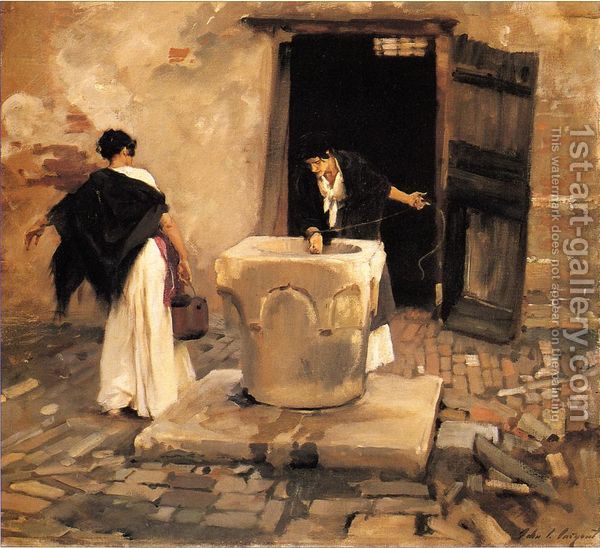
Art: Venetian Water Carriers by John Singer Sargent
The ruling of “Two that are four” has been established as referring to the liability of lashes, not sacrifices. This change allowed us to say that it could be the opinion of both Rabbi Ishmael and Rabbi Akiva.
Why is this needed? When Rabbi Yehudah, the compiler of all Mishnaic rulings, formulates an anonymous ruling, he implies that this is the majority opinion and thus the final law. Without our (somewhat forced) explanation, we would have two major authorities disagreeing with the final law.
However, there is still a problem with our answer. To receive lashes, the person must be warned. If he is warned, how can we talk about him being unaware that he eats sacrifices or that he enters the Temple?
We are forced to retract our explanation about lashes. Rather, we now answer that Rabbi Yehudah the Prince compiles conflicting opinions of different Sages in one ruling. He does so because he wants to assemble together all cases of “Two that are four.”
Art: The Discussion by Thomas Hovenden